
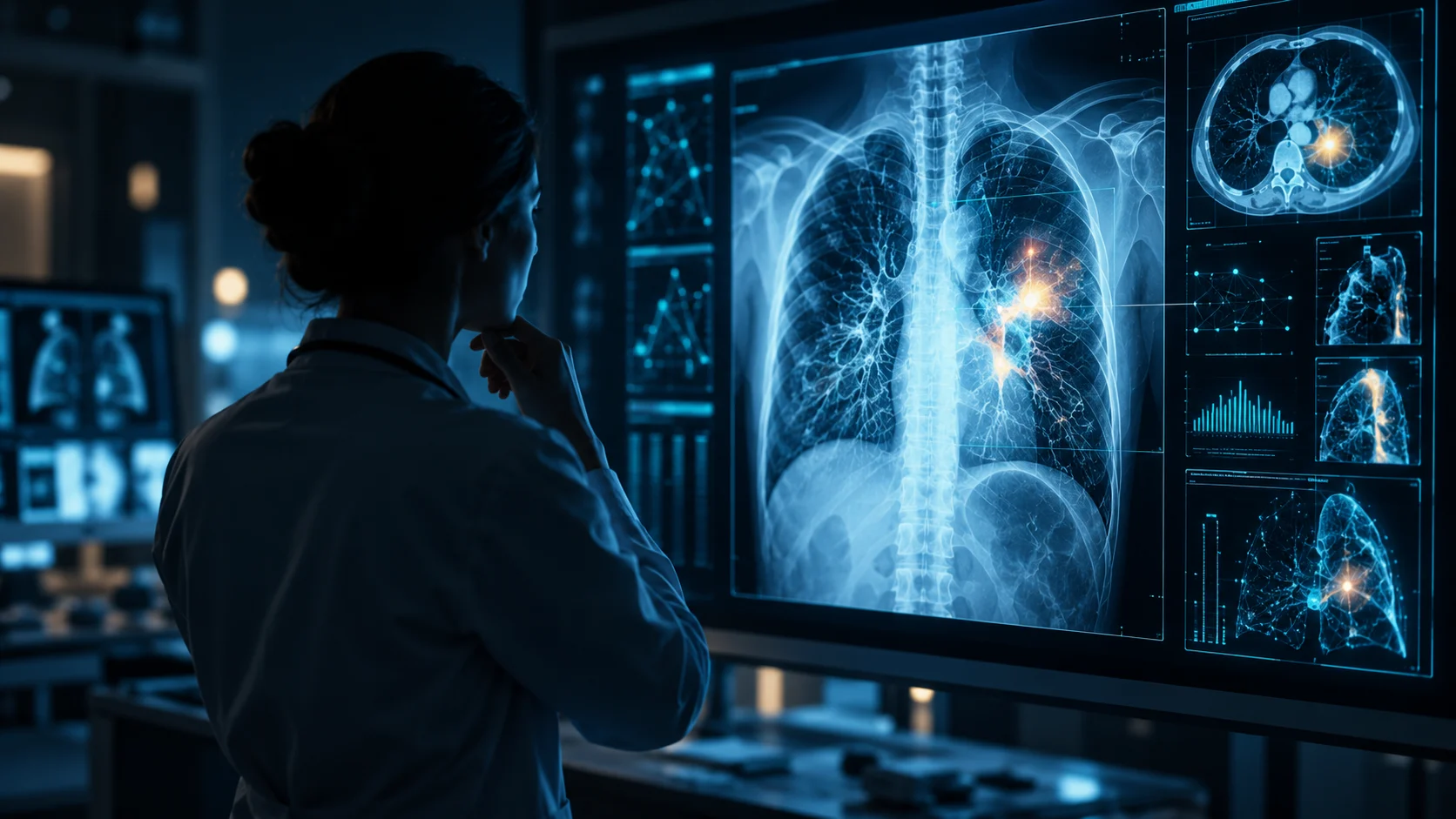
A scan contains thousands of details. Could software notice patterns humans might miss?
Artificial intelligence can be trained to identify patterns in medical images, measurements and patient records. Researchers are studying whether those patterns can help flag disease earlier. The idea is powerful: detect a warning sign while there is still time to investigate it.
But a prediction is not a diagnosis. An algorithm trained on one hospital’s patients may perform differently elsewhere. False alarms can create anxiety, while missed cases can delay care. Useful medical AI therefore needs diverse data, independent testing, clinical oversight and a clear explanation of what happens when the software is wrong.
How does a machine learn a warning sign?
A medical AI system is usually trained on many examples: images, clinical measurements or patient records paired with carefully defined outcomes. During training it learns statistical patterns that may help classify new cases. That sounds straightforward, but the hardest work often happens before training: checking labels, excluding misleading shortcuts and deciding which clinical question the model should answer. A model that recognises a hospital watermark instead of a disease pattern may score impressively in a test and still fail in practice.
Why an accurate score is not enough
Suppose a screening system flags a thousand people. How many truly have the condition, how many are unnecessarily worried, and how many are missed? These questions involve sensitivity, specificity and the prevalence of disease in the group being screened. Clinicians also need to know whether the tool improves decisions compared with current care. For Qatar, the opportunity is to evaluate promising systems using appropriate local data and independent clinical oversight, rather than assuming success elsewhere guarantees success at home.
The QScience takeaway
For healthcare innovators in Qatar, the most important question is not “Can we build a model?” It is “Can we prove that it improves patient care safely?”