
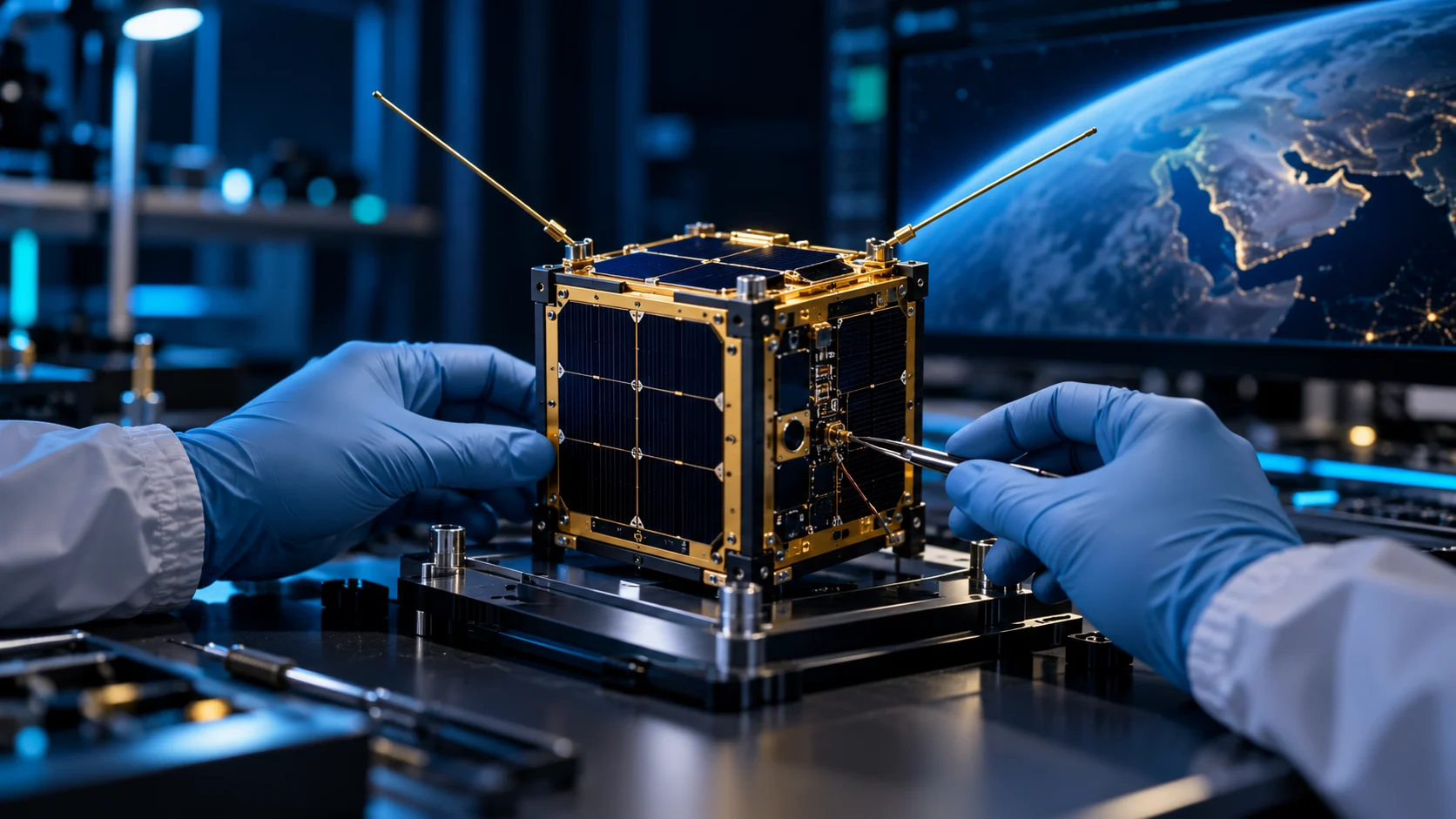
What can students learn by building a satellite instead of only studying one?
In 2026, Qatar University reported the successful launch of QUbeSat1, its first nanosatellite. The small spacecraft was developed with the involvement of researchers, academics and students. Its mission includes taking low-resolution images of Earth and communicating with the university’s ground station.
The educational value goes far beyond a photograph from orbit. A satellite project brings together electronics, software, radio communication, mechanical design and testing. Every subsystem has to work with the others, often under tight limits on mass, power and space.
What students learn by building a satellite
A small satellite is an engineering classroom in orbit. Students must think about power budgets, communications, sensors, software and the physical limits of launch. Every extra component uses mass and energy. A camera is only useful if the spacecraft can point it correctly, store its data and send it back to a ground station. This makes a satellite project an unusually clear example of systems engineering: success depends on many small parts working together.
From launch to useful learning
A launch is the most visible moment, but it is not the end of a mission. Teams must establish contact, check the satellite’s health and interpret the data they receive. Even an educational spacecraft can teach lessons about testing, teamwork and failure analysis. Qatar University’s reported QUbeSat1 project offers a local story through which readers can understand these steps. Be precise about mission objectives and reported results; do not confuse a planned capability with a confirmed scientific discovery.
The QScience takeaway
QUbeSat1 shows why hands-on engineering matters. Space technology can look distant, but its foundations begin in laboratories, classrooms and teams willing to test an idea against reality.